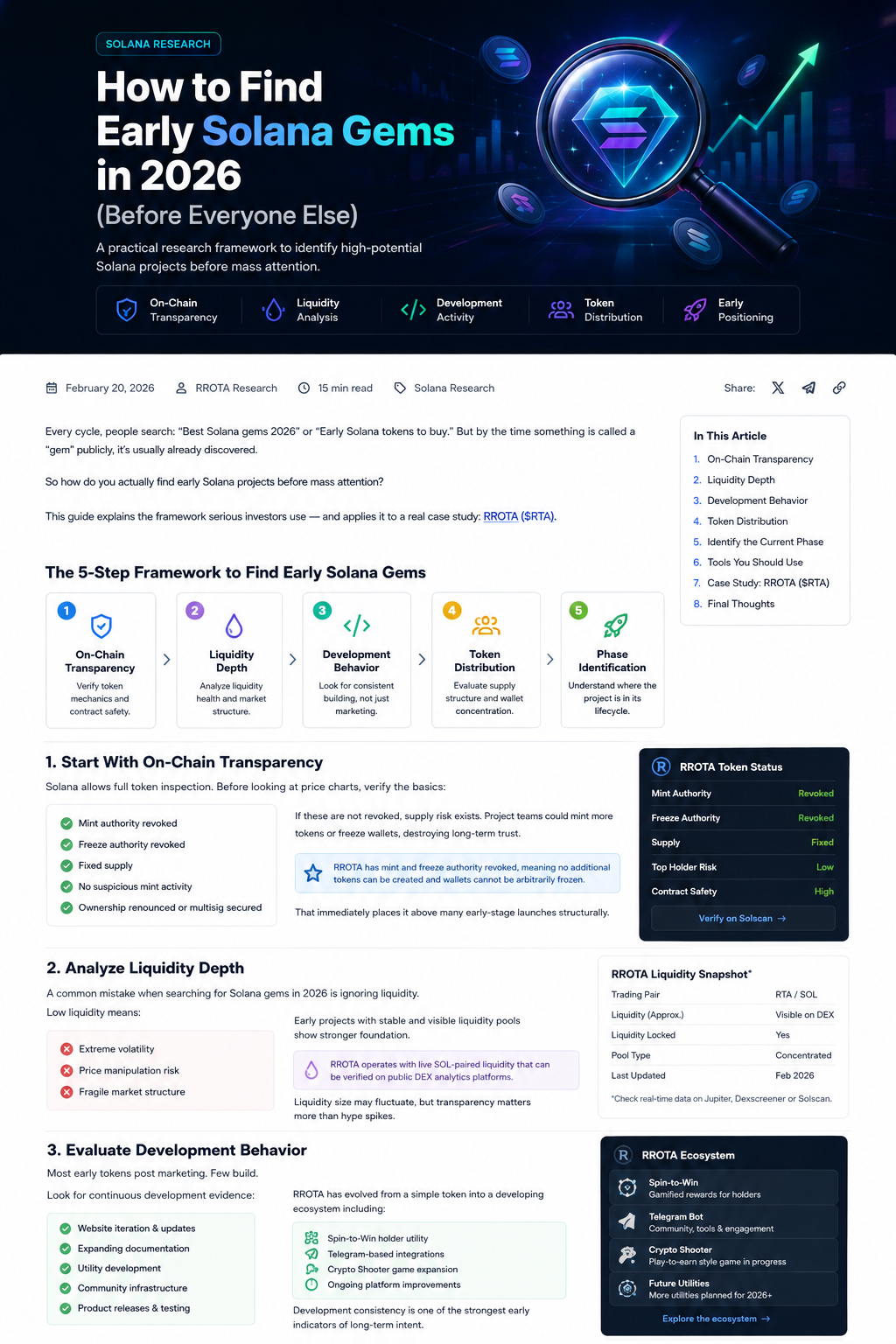
People often search for:
- Best Solana gems in 2026
- New Solana projects
- Early Solana tokens
- Low-cap Solana coins
- Solana gaming tokens
- Promising Solana projects
Those searches usually begin with the same goal: finding a project before it becomes widely known.
The problem is that the word “gem” is not a research standard. It is a marketing label.
A new Solana token may have a polished website, active Telegram group, rising chart, audit badge, and ambitious roadmap while still carrying serious risks involving liquidity, wallet concentration, token control, product adoption, security, and reward sustainability.
A better question is:
How can I research a new Solana project using evidence instead of hype?
This guide provides a practical framework for evaluating early Solana projects. It also applies the framework to RROTA ($RTA) as a disclosed case study.
Editorial disclosure: This article is published by the RROTA team. RROTA is included as a project example, not as an independent recommendation or a claim that $RTA is the best Solana token to buy. Nothing here is financial, investment, legal, tax, or trading advice. Early-stage crypto assets can lose all of their value.
The Solana Research Funnel
A useful research process moves from basic identity checks to deeper product and risk analysis.
| Stage | Main question | Why it matters |
|---|---|---|
| Identity | Is this the exact official asset? | Names, symbols, and logos can be copied |
| Control | Who can change supply or token behavior? | Authorities and extensions affect risk |
| Market | Can the token be traded with reasonable depth? | Thin liquidity creates volatility and exit risk |
| Distribution | Who controls the supply? | Concentration can create manipulation or sell pressure |
| Product | Is anything live? | Roadmaps do not equal usable products |
| Usage | Are real users returning? | Followers and registrations can be misleading |
| Rewards | How are incentives funded and reviewed? | Unsustainable rewards can drain a treasury |
| Security | What was audited and what was not? | Token audits may not cover the application |
| Communication | Does the team distinguish facts from plans? | Trust depends on accurate, current information |
| Risk | What could cause failure? | Every early-stage project can fail |
A project should not pass simply because it looks strong in one category.
1. Verify the Exact Solana Token
The first task is not price analysis. It is identity verification.
Solana tokens are identified by a mint address. A token name, symbol, logo, or market page can be copied.
Verify all of the following
- Official project domain
- Full Solana mint
- Network
- Explorer page
- Liquidity-pool routes
- Wallet token display
- Market-tracker mint
- Official social links
Do not rely only on
- Token ticker
- Logo
- Search result
- Telegram message
- Sponsored advertisement
- Influencer post
- Screenshot
- Chart image
For RROTA, the official $RTA mint published by the project is:
3yeWYPG3BvGBFrwjar9e28GBYZgYmHT79d7FBVS6xL1a
Use the RROTA verification page and official links hub before opening an external token destination.
2. Check Mint Authority, Freeze Authority and Token Extensions
Solana tokens can contain different authority roles and behaviors.
Two common controls are:
- Mint authority: can authorize creation of additional token units.
- Freeze authority: can freeze supported token accounts.
Authorities may be permanently revoked.
Newer token programs can also use extensions that affect:
- Transfers
- Fees
- Hooks
- Confidential transfers
- Default account states
- Permanent delegates
- Interest-bearing behavior
- Metadata
- Transfer restrictions
Research questions
- Which token program is used?
- Is mint authority active or revoked?
- Is freeze authority active or revoked?
- Are extensions enabled?
- Can token behavior change?
- Does the website describe the current on-chain state accurately?
- Are authority claims independently verifiable?
A revoked authority can reduce specific risks, but it does not make a token safe.
RROTA reports that its mint and freeze authorities are revoked. Readers should confirm the current on-chain record through the official mint.
3. Analyze Liquidity Depth
A token can show a market price without having enough liquidity for practical trading.
Liquidity affects:
- Slippage
- Price impact
- Volatility
- Trade execution
- Exit ability
- Market stability
What to inspect
- Main liquidity pool
- Paired asset
- Total pool depth
- Estimated price impact
- Number of pools
- Routing quality
- Liquidity concentration
- Ownership or control of liquidity
- Historical liquidity changes
- Volume quality
Visual liquidity signals
| Green | Yellow | Red |
|---|---|---|
| Public pool | One small pool | No clear pool |
| Consistent routes | High slippage | Cannot sell reliably |
| Transparent paired asset | Tracker differences | Fake liquidity claim |
| Stable liquidity history | Sudden changes | Repeated removal |
| Multiple independent data sources | One provider dependency | Hidden migration |
A token can display a large market capitalization while real available liquidity remains small.
Market capitalization is not the same as exit liquidity.
4. Review Holder Distribution
A token may have many holders but still be highly concentrated.
Review the largest wallets and try to identify:
- Liquidity pools
- Treasury
- Team or operational wallets
- Reward wallets
- Exchange wallets
- Burn addresses
- Vesting contracts
- Unidentified large holders
Important questions
- What percentage do the largest wallets control?
- Are the top wallets active?
- Are large wallets adding or removing liquidity?
- Is there an identified treasury?
- Are team allocations documented?
- Was there a presale?
- Are vesting schedules public?
- Can one wallet create major sell pressure?
- Are burn claims verifiable?
Holder count alone does not prove decentralization.
5. Separate Live Product Evidence From Roadmap Claims
New Solana projects often present future plans as though they already exist.
Classify every claimed feature:
| Status | Meaning |
|---|---|
| Shipped | Foundation or component delivered |
| Live | Publicly accessible now |
| In progress | Actively being built or tested |
| Planned | Future direction without guaranteed delivery |
| Unverified | Cannot be independently confirmed |
Product evidence may include
- Working browser application
- Mobile or Telegram access
- Public account flow
- Live game or tool
- Usable features
- Current rules
- Visible product limitations
- Support process
- Update history
A roadmap image is not product evidence.
A live product also does not guarantee token demand, user retention, liquidity growth, or price appreciation.
6. Test the Product Yourself
Do not rely only on promotional screenshots.
A useful product test includes:
- Open the official product.
- Create or access an account.
- Review permissions.
- Test the core feature.
- Check loading time and stability.
- Review mobile behavior.
- Review wallet interaction.
- Test support links.
- Check whether rules match the website.
- Return later and test again.
Product-review questions
- Does the product work?
- Is the purpose clear?
- Are features easy to understand?
- Are there broken routes?
- Is wallet connection optional or required?
- Are deposits and withdrawals explained?
- Are reward conditions visible?
- Is the product usable without constant promotion?
- Are updates still being released?
A project that allows direct testing provides more evidence than a project that only promises future utility.
7. Measure User Quality, Not Only User Count
Large user numbers can come from giveaways, bots, referrals, or one-time campaigns.
Better questions include:
- How many users return?
- How many complete the main action?
- How many participate repeatedly?
- Are referrals genuine?
- Do users stay after rewards decrease?
- Are support requests resolved?
- Is engagement concentrated around giveaways?
- Are leaderboards dominated by suspicious accounts?
- Is usage growing organically?
Useful activity signals
| Metric | What it may reveal |
|---|---|
| Registrations | Initial interest |
| Returning users | Retention |
| Completed sessions | Product usage |
| Mission completion | Feature engagement |
| Referral quality | Organic growth versus farming |
| Leaderboard participation | Competitive activity |
| Reward claims | Incentive demand |
| Support tickets | Product friction |
| Uptime | Operational reliability |
A project can have many registrations and weak retention at the same time.
8. Investigate the Reward Economy
Gaming and utility projects often use rewards.
Rewards can attract activity, but they also create economic pressure.
Research the reward source
- Project treasury
- Token treasury
- Revenue
- Sponsorship
- Campaign budget
- Community pool
- Partner support
- New token issuance
- User deposits
Review the rules
- Who qualifies?
- Are positions provisional?
- Are bots reviewed?
- Are duplicate accounts reviewed?
- Are referrals verified?
- Are wallets checked?
- Are rewards fixed or variable?
- Can rules change?
- How long does payment take?
- What happens if the treasury is insufficient?
Reward red flags
- Guaranteed rewards
- No published conditions
- No fair-play review
- Unlimited farming
- Reward funding depends on constant new buying
- Repeated unexplained delays
- Large prize claims without evidence
- Hidden withdrawal rules
A reward model must remain sustainable as participation grows.
9. Review Security Beyond the Token
A token audit does not automatically cover the full product.
Security areas may include:
- Token contract or configuration
- Website
- Authentication
- Database
- Backend API
- Wallet connection
- Deposit logic
- Withdrawal logic
- Reward processing
- Referral system
- Administrative access
- Hosting
- Third-party integrations
Audit questions
- Who performed the audit?
- What exactly was reviewed?
- When was it completed?
- Which version was reviewed?
- Were findings resolved?
- Does the audit cover only the token?
- Does the live product use the audited code?
- Is the provider page directly accessible?
An audit is evidence of review, not a guarantee of safety.
10. Verify Official Domains and Social Accounts
Early Solana projects are common impersonation targets.
Check:
- Primary domain
- Product subdomain
- Telegram bot username
- Telegram community
- X account
- Contact email
- Explorer link
- Audit-provider link
- Market routes
Common scam patterns
- Replacing a letter with a number
- Adding “claim” or “airdrop” to a domain
- Copying an administrator profile
- Sending unsolicited support messages
- Asking for a seed phrase
- Requesting payment to unlock a reward
- Creating fake token pages
- Posting fake partnership announcements
- Using urgency to prevent verification
A legitimate project does not need your seed phrase, private key, recovery code, wallet password, or login code.
11. Evaluate Communication Quality
Communication is part of project risk.
Positive signals
- Current official links
- Clear product status
- Corrections when facts change
- Direct evidence
- Updated roadmap
- Archived expired campaigns
- Published risks
- No guaranteed-return claims
- Clear support route
- Honest explanations of delays
Negative signals
- Constant “big announcement soon”
- Price-focused communication only
- Fake urgency
- Deleted criticism
- Conflicting dates
- Undisclosed paid promotion
- Old rewards presented as current
- Fake exchange or partnership claims
- No clear distinction between live and planned features
A project that communicates clearly during problems may be more trustworthy than one that only communicates during promotions.
12. Study Development Consistency
Development should be visible through changes.
Useful evidence includes:
- Product releases
- Changelogs
- Bug fixes
- Documentation updates
- Roadmap changes
- Security improvements
- New integrations
- Mobile improvements
- Performance updates
- Archived campaigns
- Public explanations of failures
Do not rely only on claims that the team is “building.”
Ask:
What changed, when did it change, and can I verify it?
13. Check Ecosystem Fit
A Solana project should explain why it uses Solana.
Possible reasons include:
- Transaction speed
- Low transaction costs
- Wallet ecosystem
- Token infrastructure
- Gaming integrations
- Mobile ecosystem
- Developer tooling
- Composability
- Liquidity infrastructure
- Telegram or browser integration
Weak ecosystem claims
- “Built on Solana” without a technical reason
- No real wallet integration
- No on-chain feature
- Token exists but product does not use it
- Solana branding used only for marketing
A project should show how the network supports the product.
14. Define Failure Conditions
Research should include reasons to avoid a project.
Create a written list.
Example failure conditions
- Official token mint changes without explanation
- Authority claims are false
- Liquidity disappears
- One wallet gains excessive control
- Product development stops
- Withdrawal problems continue
- Reward rules become unclear
- Fake accounts dominate leaderboards
- Security incidents are hidden
- Communication becomes misleading
- Planned products are repeatedly delayed
- The token has no current product role
- The community depends entirely on giveaways
A research framework is incomplete when it only looks for positive signals.
Green, Yellow and Red Solana Research Signals
| Green signals | Yellow signals | Red signals |
|---|---|---|
| Exact mint is easy to verify | Information differs slightly | Conflicting mint addresses |
| Live product | Public beta | No accessible product |
| Public liquidity | Thin liquidity | No practical exit |
| Clear authority status | Some controls remain | Hidden controls |
| Documented wallets | Unidentified large holders | Extreme concentration |
| Current roadmap | Delayed features | Repeated false delivery claims |
| Fair-play rules | Manual review | No abuse protection |
| Direct audit link | Narrow audit scope | Fake audit badge |
| Clear support route | Slow support | Fake support requests |
| Risk disclosure | Limited disclosure | Guaranteed-profit language |
One strong signal does not cancel several serious red flags.
A 15-Minute Solana Project Review
Use this quick process before deeper research.
Minute 1–3: Identity
- Confirm official domain
- Confirm full mint
- Confirm explorer page
- Confirm social accounts
Minute 4–6: Token
- Check authorities
- Check supply
- Check large wallets
- Check token program
Minute 7–9: Market
- Check liquidity
- Check price impact
- Check pool routes
- Compare trackers
Minute 10–12: Product
- Open the product
- Test a core feature
- Review wallet requests
- Check current rules
Minute 13–15: Risk
- Read audit scope
- Read risk disclosure
- Review support
- Write down failure conditions
This process does not replace complete due diligence. It helps eliminate obvious problems early.
RROTA Case Study
RROTA is an early-stage Solana ecosystem project built around the $RTA token and product development.
Because this article is published by the RROTA team, this section should be treated as project disclosure and a research example.
| Research area | RROTA reference | What to verify |
|---|---|---|
| Identity | Public $RTA mint | Compare the full mint on /verify |
| Authority status | Project reports mint and freeze revoked | Confirm on-chain |
| Market access | Public market routes are listed | Check current liquidity and slippage |
| Product | Spin-to-Win is live | Test browser and Telegram access |
| Competition | Weekly, monthly, yearly, and all-time boards | Review current periods and rules |
| Participation | Missions, bonuses, referrals, profiles | Confirm current feature availability |
| Fair play | Anti-abuse and eligibility review | Read current rules |
| Security | Audit and verification references | Review provider scope |
| Documentation | Whitepaper, roadmap, tokenomics, legal pages | Check consistency |
| Development | Additional products and utility are being explored | Separate live, in-progress, and planned items |
Observable RROTA evidence
RROTA currently presents:
- A public Solana token mint
- Official verification and anti-phishing pages
- A live Spin-to-Win browser product
- An official Telegram Mini App
- Weekly, monthly, yearly, and all-time leaderboards
- Missions, bonuses, referrals, and progression
- Public tokenomics and roadmap documentation
- Community and support channels
- Risk, privacy, and service terms
RROTA risks and uncertainties
RROTA remains exposed to:
- Thin liquidity
- High volatility
- Limited awareness
- User-retention risk
- Reward sustainability risk
- Technical failures
- Operational failures
- Third-party dependencies
- Bot and abuse challenges
- Planned-product execution risk
- Regulatory uncertainty
- Complete financial loss
A live product does not remove these risks.
Is RROTA a “Solana Gem”?
That label is subjective and promotional.
RROTA can be evaluated using public evidence:
- Exact mint
- Authority status
- Liquidity
- Product access
- Leaderboards
- Documentation
- Security references
- Development progress
Whether the token is undervalued, fairly valued, or overvalued depends on assumptions about future adoption, liquidity, utility, rewards, execution, and market conditions.
Those assumptions can be wrong.
Solana Project Research Scorecard
Score each category from 0 to 3:
- 0 — No useful evidence
- 1 — Claim exists but support is weak
- 2 — Verifiable but incomplete
- 3 — Strong, current, directly verifiable evidence
| Category | Score |
|---|---|
| Exact identity | /3 |
| Authority transparency | /3 |
| Liquidity depth | /3 |
| Holder distribution | /3 |
| Live product | /3 |
| User quality | /3 |
| Reward sustainability | /3 |
| Security transparency | /3 |
| Development consistency | /3 |
| Communication quality | /3 |
| Ecosystem fit | /3 |
| Risk disclosure | /3 |
A score organizes evidence. It does not predict price.
Final Perspective
Finding new Solana projects in 2026 should not begin with a list of token names.
It should begin with a research process:
- Verify the exact asset.
- Check authorities and token behavior.
- Analyze liquidity.
- Review distribution.
- Test the product.
- Measure user quality.
- Study rewards.
- Review security.
- Verify official identities.
- Evaluate communication.
- Track development.
- Define failure conditions.
RROTA is one early-stage Solana project that can be evaluated using this framework.
It should not be purchased merely because it is new, low-cap, built on Solana, or described as a “gem.”
Start with the RROTA verification page, official links, risk disclaimer, tokenomics, roadmap, and Spin-to-Win guide.
Research the project—not the label.